



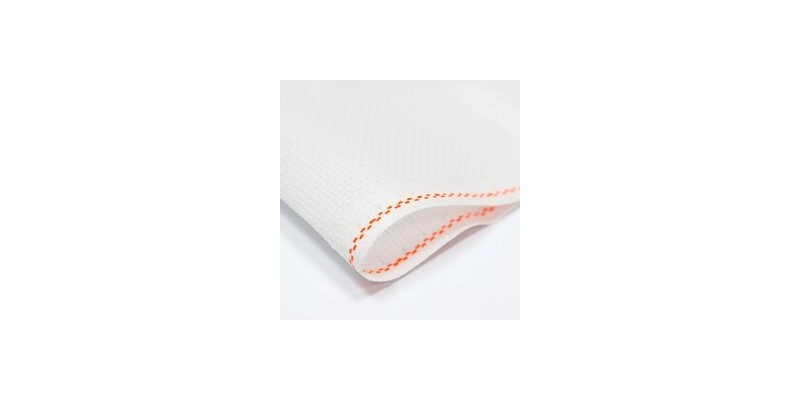
Aida fabric and embroidery needles: choosing the right combination
Anyone who starts cross stitch soon comes across terms such as 14 count Aida, 5.5 crosses per centimetre and size 24 embroidery needles. Experienced stitchers are familiar with these descriptions, but beginners may not immediately know which fabric and needle are suitable for a particular project.
The choice of fabric determines the size and fineness of the crosses. The embroidery needle must then suit the size of the openings in the fabric and the number of strands of embroidery thread being used. With the right combination of Aida fabric, thread and needle, stitching becomes more comfortable, the fabric is less likely to be damaged and the finished result is more even.
At Verelana, you will find Zweigart Aida fabric in 14, 16 and 18 count. We also offer blunt embroidery needles, sharp embroidery needles and special Bohin ball-point needles for different embroidery techniques.
What is Aida fabric?
Aida is an evenly woven embroidery fabric specially designed for cross stitch. Its woven structure forms clearly visible squares with openings at the corners. You do not need to count individual fabric threads: each visible square forms the basis for one cross stitch.
This clear structure makes Aida suitable for both beginners and experienced stitchers. Beginners can easily see where the needle should pass through the fabric. Experienced embroiderers appreciate Aida for its regular and easy-to-follow stitch layout.
Aida is usually made from cotton and is available in different counts, colours and finishes. The count determines how many crosses fit within a certain area and therefore directly affects the size and appearance of the finished embroidery.
What does count mean for Aida fabric?
The count indicates how many cross stitches fit into one English inch. One inch equals 2.54 centimetres.
On 14 count Aida, 14 crosses fit into one inch. This equals approximately 5.5 crosses per centimetre. On 18 count Aida, 18 crosses fit into one inch, or approximately 7.1 crosses per centimetre.
The basic rule is simple:
- the lower the count, the larger the openings and the crosses;
- the higher the count, the smaller and finer the openings and crosses;
- the same design becomes smaller on a higher count fabric;
- the same design becomes larger on a lower count fabric.
A design measuring 140 by 140 stitches will be approximately 25.5 by 25.5 centimetres on 14 count Aida. On 18 count Aida, the same design will measure approximately 19.7 by 19.7 centimetres. The choice of fabric therefore determines not only how fine the stitching is, but also the final size of the project.
Which Aida counts are available?
Aida is available in various counts. Some are widely used, while others are now relatively uncommon.
6 count and 8 count Aida
6 count and 8 count Aida are very coarse fabrics with large, clearly visible openings. They are mainly used for educational projects, very large cross stitches, special decorative applications or by stitchers who need particularly large holes.
These counts are rarely used for standard cross stitch today. The finished embroidery becomes quite large and has a coarser appearance.
11 count Aida
11 count Aida has approximately 4.5 crosses per centimetre. This fabric is also coarser than the counts most commonly used in modern embroidery kits.
11 count Aida may be suitable for beginners, children or stitchers who find small openings difficult to see. It is used less often for modern, highly detailed cross stitch designs.
14 count Aida
14 count Aida has approximately 5.5 crosses per centimetre and is one of the most commonly used Aida counts.
The openings are clearly visible, while the finished embroidery still remains nicely detailed. This makes 14 count Aida suitable for beginners as well as experienced stitchers who prefer to work comfortably.
16 count Aida
16 count Aida has approximately 6.3 crosses per centimetre. The crosses are slightly smaller than those on 14 count Aida, giving the finished work a finer and more compact appearance.
This count is frequently used in detailed embroidery kits. It offers a good balance between refinement and ease of stitching.
18 count Aida
18 count Aida has approximately 7.1 crosses per centimetre. This finer fabric is suitable for detailed designs and for stitchers who enjoy working with smaller crosses.
The same design becomes noticeably smaller on 18 count Aida than on 14 or 16 count. Good lighting is especially important when working with this finer count.
20 count Aida
20 count Aida has approximately 8 crosses per centimetre and is very fine. It is used less often and is mainly suitable for experienced stitchers who want to create very small and detailed cross stitches.
Which Aida fabric does Verelana sell?
At Verelana, we sell only high-quality Zweigart Aida fabric in:
- 14 count Aida;
- 16 count Aida;
- 18 count Aida.
These three counts are particularly useful for modern cross stitch. Together, they provide enough choice for accessible projects as well as very fine embroidery.
Our Aida fabric is available pre-cut in different sizes and colours. This allows you to choose the fabric that suits the stitch count of your design and the desired appearance of the finished work.
14 count Aida is suitable when you prefer clearly visible openings and slightly larger crosses. 16 count Aida produces a finer and more compact result. 18 count Aida is ideal for detailed designs with smaller cross stitches.
Zweigart: quality and evenness
Zweigart is a well-known German manufacturer of embroidery and needlework fabrics. The brand is recognised for evenly woven fabric with carefully formed squares and openings.
This regularity is especially important in cross stitch. If the weave is uneven, crosses may become wider or taller and the design may become distorted. On quality fabric, the squares remain well proportioned and the stitches retain the same shape and size throughout the project.
You will notice this difference while stitching:
- the openings are clearly visible;
- the fabric threads are evenly distributed;
- the squares are consistently formed;
- the counted chart can be followed accurately;
- the embroidery is less likely to become distorted.
Zweigart offers several types of counted embroidery fabric. Aida is the best-known choice for cross stitch because the openings are clearly visible and each square corresponds directly to one cross stitch.
Which Aida fabric is included in our embroidery kits?
With a complete embroidery kit, you normally do not need to choose the count yourself. The manufacturer selects the fabric according to the design, the number of stitches, the required level of detail and the finished size.
Our embroidery kits contain different counts and types of embroidery fabric. The fabric included is always stated in the product information.
Luca-S: almost always 16 count Aida
Luca-S embroidery kits almost always contain 16 count Aida. This fabric has approximately 6.3 crosses per centimetre and creates a fine, neat result without making the openings extremely small.
16 count Aida is very well suited to the detailed designs by Luca-S. Landscapes, animals, flowers, portraits, still lifes and city scenes often contain many colours and subtle transitions. These details can be reproduced clearly on 16 count Aida, while the finished embroidery remains more compact than on 14 count Aida.
Luca-S embroidery kits generally contain:
- 16 count Aida or the counted fabric selected for the design;
- the required embroidery threads;
- an embroidery needle;
- a clear counted chart;
- instructions for the stitches used.
You can therefore begin immediately with the fabric, threads and needle selected for the design.
Riolis: often 14 count Aida
Many Riolis embroidery kits contain Zweigart 14 count Aida. This count is slightly coarser than 16 count Aida and has approximately 5.5 crosses per centimetre.
14 count Aida is comfortable to stitch on and works well with the recognisable designs and threads used by Riolis. Depending on the kit, other counts or types of embroidery fabric may also be included.
Other brands
The fabric selected by other embroidery brands can vary. Some designs include 14 count Aida, while others contain 16 count, 18 count or another counted fabric.
Always check the product information when you:
- prefer a particular count;
- want to stitch on a coarser or finer fabric;
- want to know the final size of the embroidery;
- prefer a particular fabric colour.
Why use a blunt embroidery needle on Aida?
For ordinary cross stitch on Aida, you normally use an embroidery or tapestry needle with a blunt, rounded point and a relatively large eye.
The needle does not need to create a new hole in the fabric. It should pass through the existing openings in the Aida. A sharp needle may accidentally pierce between or through the woven fabric threads. This can damage the fabric or place the cross stitch beside the correct opening.
The larger eye makes it easier to thread several strands of embroidery floss. Embroidery floss often consists of six separable strands. Depending on the fabric count and the pattern instructions, you may use one, two, three or more strands.
A good embroidery needle should:
- pass smoothly through the opening;
- not damage the thread;
- not enlarge the fabric openings unnecessarily;
- have an eye large enough for the number of strands being used.
Which needle size should you use with each Aida count?
Embroidery needle sizing works in the opposite way to what many beginners expect:
- a lower number indicates a thicker needle;
- a higher number indicates a finer needle.
For coarse Aida with large openings, you therefore use a thicker needle with a lower number. For fine Aida with small openings, you choose a thinner needle with a higher number.
The table below shows how many crosses each Aida count has per centimetre and which embroidery needle is generally recommended.
| Aida fabric | Crosses per centimetre | Recommended embroidery needle |
|---|---|---|
| 6 count Aida | 2.45 | Size 18 |
| 8 count Aida | 3.3 | Size 20 |
| 11 count Aida | 4.5 | Size 22 |
| 14 count Aida | 5.5 | Size 24 |
| 16 count Aida | 6.3 | Size 26 |
| 18 count Aida | 7.1 | Size 26 or 28 |
| 20 count Aida | 8 | Size 28 |
This table is a practical guideline. The type of thread and the number of strands used also play a role.
When stitching on coarse Aida with several strands, the eye of the needle must provide enough room. On very fine fabric with only one or two strands, a finer needle is more suitable.
The correct needle should pass through the opening without excessive resistance. If you need to use force or the thread begins to fray quickly, the needle may be too fine. If the needle visibly stretches the openings, it is probably too thick.
When should you use a sharp embroidery needle?
For full cross stitches on Aida, a blunt embroidery needle is normally the best choice. Some techniques, however, are easier with a sharp needle.
This applies, for example, to:
- backstitches that do not pass through an existing opening;
- quarter stitches;
- three-quarter stitches;
- stitches through the centre of an Aida square;
- special finishing stitches;
- attaching small details or beads.
A sharp needle can deliberately pierce the fabric threads. Use it only when the pattern or technique requires this.
Some stitchers use a blunt needle for cross stitches and keep a fine sharp needle nearby for backstitch and special details.
What is a ball-point embroidery needle?
A ball-point embroidery needle has a small rounded ball at the end instead of a standard blunt point.
This ball glides over the fabric threads and finds the existing openings in the Aida more easily. The needle is therefore less likely to pierce a fabric thread, the embroidery floss or an already completed cross stitch.
With a ball-point needle, you are less likely to stitch:
- through a fabric thread;
- beside the correct opening;
- into previously stitched thread;
- through an existing cross stitch;
- between the individual strands of embroidery floss.
The Bohin ball-point needles in our range are available in different lengths and thicknesses. The best choice depends on the fineness of the fabric, the size of your hands and your personal stitching method.
Who may benefit from a ball-point needle?
A ball-point needle can be useful for:
- beginners;
- stitchers who find fine openings difficult to see;
- people who often split fabric or thread strands by accident;
- large cross stitch projects with many areas already completed;
- stitching on Aida and other counted fabrics;
- stitchers who work with both hands using an embroidery stand.
Especially when bringing the needle through from the back of the fabric, the small ball can help find the correct opening. You do not always need to see the hole clearly at once. By gently moving the needle across the fabric, the ball finds the existing opening more easily.
The choice between a standard blunt embroidery needle and a ball-point needle remains personal. Some stitchers find that a ball-point needle allows them to work noticeably faster and more comfortably. Others prefer the direct movement of a traditional blunt needle.
A ball-point needle is not suitable for every technique. For backstitch, quarter stitches and other stitches where you deliberately need to pierce a fabric thread or the centre of a square, a sharp needle may be more practical.
How many strands of embroidery thread should you use?
The count of the Aida affects not only the needle size, but also the number of strands of embroidery thread.
On coarse Aida, more strands are usually needed to cover the fabric sufficiently. On finer Aida, fewer strands are generally used because the crosses are smaller and closer together.
As a general guideline:
- on 6 count and 8 count Aida, several strands or thicker embroidery thread are often used;
- on 11 count Aida, three strands are often used;
- on 14 count Aida, two or three strands are commonly used;
- on 16 count Aida, two strands are very common;
- on 18 count Aida, one or two strands are often used;
- on 20 count Aida, one strand may sometimes provide sufficient coverage.
The desired effect also matters. More strands provide fuller coverage and leave less fabric visible. Fewer strands create a finer and lighter appearance.
When working with an embroidery kit, always follow the included instructions. The designer has selected the combination of fabric, colours and number of strands to create the intended finished result.
How do you calculate the size of your embroidery?
If you know the number of stitches in a pattern, you can easily calculate how large the embroidery will be on a particular Aida count.
Use the following formula:
Number of stitches ÷ crosses per centimetre = size in centimetres.
For a design that is 200 stitches wide, for example:
- on 14 count Aida: 200 ÷ 5.5 = approximately 36.4 cm;
- on 16 count Aida: 200 ÷ 6.3 = approximately 31.7 cm;
- on 18 count Aida: 200 ÷ 7.1 = approximately 28.2 cm.
A design measuring 200 stitches will therefore be almost eight centimetres narrower on 18 count Aida than on 14 count Aida.
Always allow enough extra fabric around the design. You need this margin to:
- place the fabric in an embroidery hoop or stand;
- hold the work comfortably;
- finish the edges;
- frame the completed embroidery later.
An additional margin of at least five to ten centimetres on each side is usually advisable. Special finishing methods or wide mounts may require more fabric.
Which colour Aida should you choose?
White and ecru are the most commonly used colours because almost all embroidery thread colours remain clearly visible on them. The colour of the fabric can, however, be an important part of the design.
Black Aida creates a strong contrast and is particularly suitable for:
- starry skies;
- night scenes;
- bright colours;
- silhouettes;
- designs where the dark background does not need to be fully stitched.
Stitching on black Aida requires good lighting. A light-coloured cloth or lamp placed beneath the work can make the openings easier to see.
Ecru creates a warmer and softer appearance than pure white. It suits classic, rustic and nostalgic designs.
Choose the colour of the Aida not only according to personal preference, but also according to the design and the areas of fabric that will remain visible.
Practical tips for stitching on Aida
Start in the centre
Find the centre of the fabric and the centre of the counted chart. Starting in the middle reduces the risk of placing the design incorrectly on the fabric.
Finish the edges
A cut piece of Aida may fray while you work. Finish the edges beforehand by hemming, zigzag stitching or temporarily covering them with tape.
Keep the fabric evenly tensioned
Use an embroidery hoop or stand to keep the fabric evenly tensioned. Tighten it firmly, but not so tightly that the squares become distorted.
Use good lighting
Good lighting is especially important when working with:
- dark Aida;
- 18 or 20 count Aida;
- patterns containing many similar colours;
- large projects;
- embroidery during the evening.
An embroidery lamp or magnifying lamp can help make the openings, symbols and colour differences easier to see.
Keep all cross stitches in the same direction
Work the lower half of each cross stitch in the same direction and place the upper half over it in the opposite direction. This gives the embroidery a regular and neat surface.
Do not use excessively long threads
A very long thread can twist, become fluffy or form knots while stitching. It is better to use shorter lengths and replace the thread when it becomes rough or damaged.
Buy Aida fabric and embroidery needles at Verelana
At Verelana, you will find high-quality Zweigart Aida fabric in 14, 16 and 18 count. The fabric is available pre-cut in different sizes and colours.
Our range also includes:
- blunt embroidery needles;
- sharp embroidery needles;
- Bohin ball-point needles;
- embroidery thread;
- embroidery hoops;
- embroidery stands;
- embroidery lamps;
- other practical embroidery accessories.
Are you unsure whether 14, 16 or 18 count Aida is the right choice? Or do you not know which embroidery needle is best suited to your fabric and thread? In our embroidery shop in Sint-Truiden, we are happy to help you choose the right combination.
With evenly woven Zweigart Aida, the correct needle size and the appropriate number of thread strands, you can work more comfortably and each cross stitch will appear clean and even.